Inconsistent fills, dripping, stringing between containers, foam and splashing are the most common complaints we hear about liquid filling. The machine usually gets the blame. In our experience, the real cause is most often the filling machine nozzle, or how the product, the nozzle and the container are working together.
The good news is that most of these problems are easy to fix once you know where to look. Here are the issues we see most often, what causes them, and how to choose the right nozzle for your product.
In this article
Quick Troubleshooting Guide
| What you see | Likely cause | Where to start |
|---|---|---|
| Dripping between fills | Nozzle with no positive shut-off, or vibration breaking the product’s surface tension | A PSO, pinch valve or suck-back nozzle |
| Stringing onto the next container | Thick or stringy product with no clean cut-off | A suck-back nozzle |
| Fill volumes vary | Air in the product or system, or back pressure from a nozzle that’s too small | Check product supply and aeration, then nozzle size |
| Foaming or splashing | Product hitting the container too hard | An outward-opening PSO nozzle, slower fill speed or bottom-up filling |
| Slow or difficult fills | Thick product, small nozzle, narrow container opening | A larger nozzle, plug nozzle or different container |
1. The Wrong Nozzle
The nozzle controls how product leaves the machine and enters the container: how fast it flows, how cleanly it stops, and whether it drips, strings or foams. A nozzle that’s perfect for runny detergent can be a disaster on honey, and vice versa.
Because the problem shows up as inconsistent fills, dripping or mess, it’s easy to assume the machine is faulty. Very often the machine is measuring perfectly and the nozzle simply isn’t suited to the product.
✓ The fix:
Match the nozzle to the product first. See the nozzle guide below, or call us and we’ll recommend one.
2. Air in the Product or System
A piston filler measures volume. If there’s air mixed in with the product, part of every fill is air, and fills become inconsistent. Air gets in two common ways:
- Aerated product. Products that have been mixed or pumped vigorously can be full of fine air bubbles.
- Thick product that doesn’t flow to the machine. If a thick product can’t flow from the source to the machine fast enough, the machine draws gulps of air into the system along with the product.
✓ The fix:
Give aerated product time to settle before filling. For thick products, make sure product reaches the machine freely: keep the source close and above the machine, and use a short, wide supply hose and inlet suited to the viscosity.
3. Back Pressure From a Nozzle That’s Too Small
When a thick product is pushed through a nozzle that’s too small, the machine has to force it out. Pressure builds up behind the nozzle. Then, when the machine changes over from filling to drawing in the next shot, that trapped pressure pushes product back towards the source. The next shot doesn’t fill cleanly, and fill volumes become inconsistent.
✓ The fix:
Use a nozzle with a bore large enough for the product’s viscosity, or a nozzle designed for thick products, such as a suck-back or plug nozzle.
4. Product, Container and Nozzle Mismatch
The product, the container opening and the nozzle size all have to work together. The classic problem is a thick product going into a container with a narrow opening. The nozzle has to fit inside the neck, but a nozzle that small creates back pressure with a thick product, and the fill becomes slow, messy and inconsistent.
✓ The fix:
Choose the largest nozzle the container opening allows, and slow the fill to suit. If the container opening is simply too narrow for the product, it may be worth considering a container with a wider opening. Talk to us before you order a large run of containers.
5. Over-Adjusting the Machine to Compensate
When fills are inconsistent, the natural reaction is to adjust the machine: more volume, a different speed, another tweak. But if the real cause is the nozzle, air in the system or back pressure, each adjustment just moves the problem around. Settings drift further from where they should be, and the fills get worse rather than better.
✓ The fix:
Stop adjusting and find the cause. Return the machine to its baseline settings, check the nozzle, the product supply and the container, then fine-tune. If you’re stuck, call us. Phone and video support is free for the life of your hire, or for the life of the machine for the original purchaser, and you’ll talk to the people who design and build the machines.
Types of Filling Nozzles Explained
Here’s what each type of nozzle is designed for, and the products it suits best.
Standard Nozzles
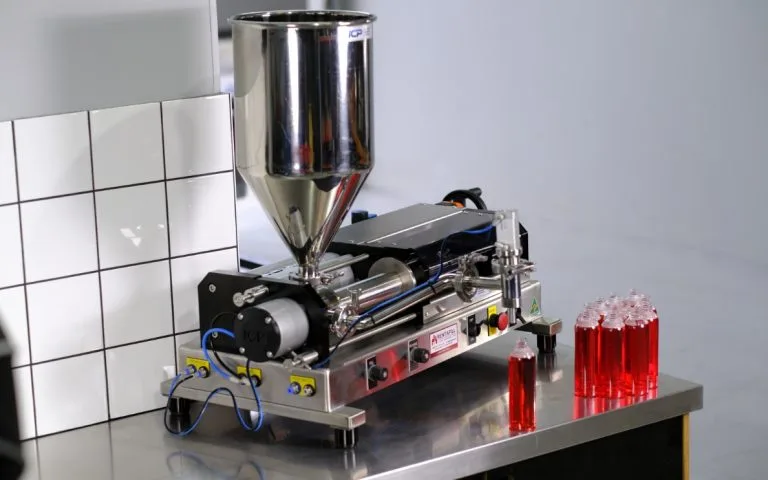
Standard nozzles have no positive shut-off. They work well on small machines such as the ICP-1 benchtop filler for the majority of products, especially creamy products that create their own surface tension, such as conditioner and some shampoos. The product holds in the nozzle between fills.
Best for: Benchtop and semi-automatic machines filling most products. On automatic machines, vibration can break the product’s surface tension and cause dripping, so a shut-off nozzle is often a better choice.
Inward-Opening PSO Nozzles
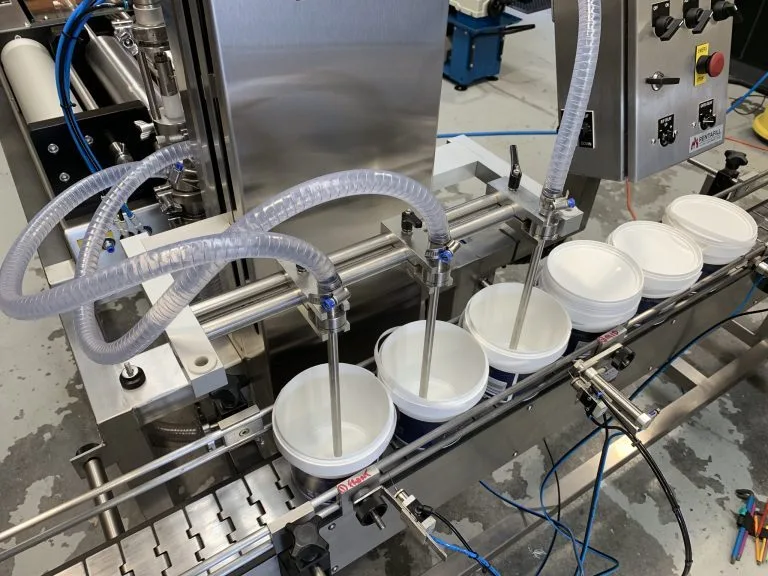
A stainless steel plunger inside the nozzle seals between fills, giving a positive shut-off (PSO). The plunger opens inward to let product flow, then closes cleanly at the end of each fill.
Best for: Runny, free-flowing products such as detergents, water and runny shampoo.
Sizes: 12, 16, 19 and 25 mm. The size depends on the fill volume and the container opening; for example, a 25 mm inward-opening PSO nozzle suits 5-litre jerry cans.
Outward-Opening PSO Nozzles
Also designed for flowing products, but the plunger has an O-ring and opens outwards. This breaks up the flow as it leaves the nozzle, giving a softer fill and reducing foaming.
Best for: Flowing products that foam, and sugar syrups, which can cause inward-opening nozzles to stick.
Suck-Back Nozzles
Purpose-built for thick products that either string or don’t flow freely. At the end of each fill, the nozzle sucks product back up into itself. With stringy products, the string is drawn back up the nozzle, so the filled container moves on cleanly without stringing over the next one.
Best for: Thick, stringy or slow-flowing products.
Plug Nozzles
Designed for very thick products going into containers with wide openings. The nozzle fills from above the container rather than inside it.
Best for: Very thick products such as jams, chutneys and similar spreads, in wide-mouth jars and tubs.
Pinch Valve Nozzles
A pinch valve gives a positive shut-off in a compact nozzle that suits small volumes.
Best for: Small-volume fills that need a positive shut-off, such as spirits, oils and essential oils.
Shop: 6 mm pinch valve nozzle
See the full range of filling machine nozzles and accessories in our online store.
Which Nozzle for Which Product?
| Product | Examples | Nozzle to consider |
|---|---|---|
| Runny, free-flowing | Detergents, water, runny shampoo | Inward-opening PSO |
| Flowing and foamy | Foaming liquids | Outward-opening PSO |
| Sugar syrups | Syrups, cordials | Outward-opening PSO |
| Creamy, holds its own tension | Conditioner, some shampoos | Standard nozzle on benchtop machines; a shut-off nozzle on automatic machines |
| Thick or stringy | Honey, gels, thick sauces | Suck-back |
| Very thick, wide-mouth containers | Jams, chutneys | Plug |
| Small volumes needing a shut-off | Spirits, oils, essential oils | Pinch valve |
Get it right before it arrives. Send us your containers and tell us how your product behaves: how thick it is, whether it foams or strings, and the fill temperature. Before your hire or purchase, we’ll set the machine up with the right nozzle for your product. Within reason, there’s no charge.
Frequently Asked Questions
Common questions about filling problems and nozzles.
Why is my filling machine dripping?
Dripping is usually caused by a nozzle with no positive shut-off, or, on automatic machines, vibration breaking the product’s surface tension. A positive shut-off (PSO), pinch valve or suck-back nozzle usually solves it.
Why are my fill volumes inconsistent?
The most common causes are air in the product or system, back pressure from a nozzle that is too small for a thick product, and over-adjusting the machine to compensate. Check the product supply, nozzle size and container opening before changing machine settings.
What is a PSO nozzle?
A PSO (positive shut-off) nozzle has a plunger that seals the nozzle between fills to stop dripping. Inward-opening PSO nozzles suit runny products such as detergents and water; outward-opening PSO nozzles give a softer fill that reduces foaming and suit sugar syrups.
How do I stop a thick product from stringing?
Use a suck-back nozzle. At the end of each fill, it draws product back up into the nozzle, so the string is pulled back instead of trailing onto the next container.
What nozzle should I use for jam or chutney?
A plug nozzle, which is designed for very thick products filled from above into wide-mouth containers such as jars and tubs.
Having Trouble With Your Fills?
Before you adjust the machine again, talk to the people who design and build it. Tell us your product, container and nozzle, and we’ll help you find the cause.
Call 02 9987 1871Shop NozzlesHire Filling MachinesContact Us